Page 12 of 14
The splintering of the Internet is not a new phenomenon
There has been increasing discussion around the concept of the “splinternet”: that proprietary devices like the iPad or proprietary sites like Facebook are acting to splinter the old, connected Web into discrete, fragmented, and self-contained units. But the “golden age” was hardly golden, and today’s Web is, if anything, better than it used to be in terms of interconnectivity. Certainly it’s important to recognize fragmentation issues today, but let’s not pretend it’s a new problem.
April 2010 / 3 min.
My first look at historical shifts in anti-vaccination rhetoric
There is a long history of opposition to vaccination, opposition that dates back to its earliest uses in Europe and North America to fight smallpox. Opponents have made claims ranging from accusations that vaccination interferes with “God’s will” to claims that it actually contributed to the spread of smallpox instead of preventing it.
April 2010 / 2 min.
Science and Protestantism: why is evolution a target?
 Why is it that modern Protestant evangelicals and fundamentalists seem to struggle with accepting science today? Why does this struggle emerge especially around biology, particularly evolution? And why have many evangelicals turned to approaches like “Intelligent Design,” which instead of replacing science with religion, instead seeks to co-opt science within terms acceptable to Protestant evangelicalism?
April 2010 / 3 min.
The Statute of Anne: “An Act for the Encouragement of Learning”
300 years ago Saturday, the Statute of Anne created the first modern system of copyright.
April 2010 / 2 min.
Vaccination and anti-vaccination at the turn of the 20th century
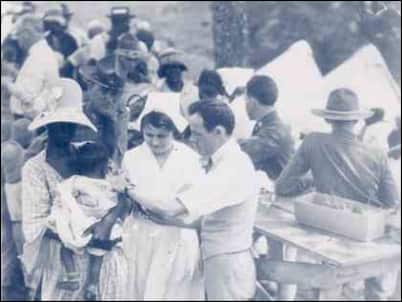 By near the end of the nineteenth century, Jennerian vaccination had become a generally (but not universally) accepted medical practice. But it still had its critics.
April 2010 / 3 min.
Smallpox inoculation and quarantine in colonial America
In colonial America, quarantine was a state-sponsored restriction on individual liberty in the name of public health, and was accepted by the public. Early inoculation, on the other hand, was done by individuals, and was immediately resisted by the public.
March 2010 / 3 min.
Research preview: the historical case for vaccination
I’m researching how the scientific and medical community presented and developed itself such that the public moved from rioting to cooperation with vaccination.
February 2010 / 5 min.
Is the future of scholarship social? Should it be?
Reflecting on the release of Apple’s iPad, David Weinberger suggests that it is a device focused on consuming content and not producing it, and argues that the true future of reading is to become more social. Jim Milles questions scholars’ desire for this vision of the future.
January 2010 / 3 min.
Professionalization and the self-replication of university professors
There has been an ongoing discussion regarding the challenges facing higher education in the United States. These challenges are especially acute in the humanities, and of course a budget crisis and recession only magnifies existing problems.
January 2010 / 2 min.
Historians need to stop obsessing over writing books
Why are historians so obsessed with writing books? Now that I’m on my second quarter of a PhD program in the History of Science, I am continuing to think about why I am doing this and what history (and History) has to offer, both to me and to the world at large. One concern I already have is with the apparent obsession with the book as the primary mechanism of disseminating the work of historians.
January 2010 / 4 min.